7 min readArrow Industries
Why Borewell Caps Crack — and How to Prevent It
Grey iron is strong in compression and weak in tension, so a cap almost never fails where the load is — it fails at the boss root, at a casting defect, or because it was overtightened on installation. The four failure modes, and what to specify instead.
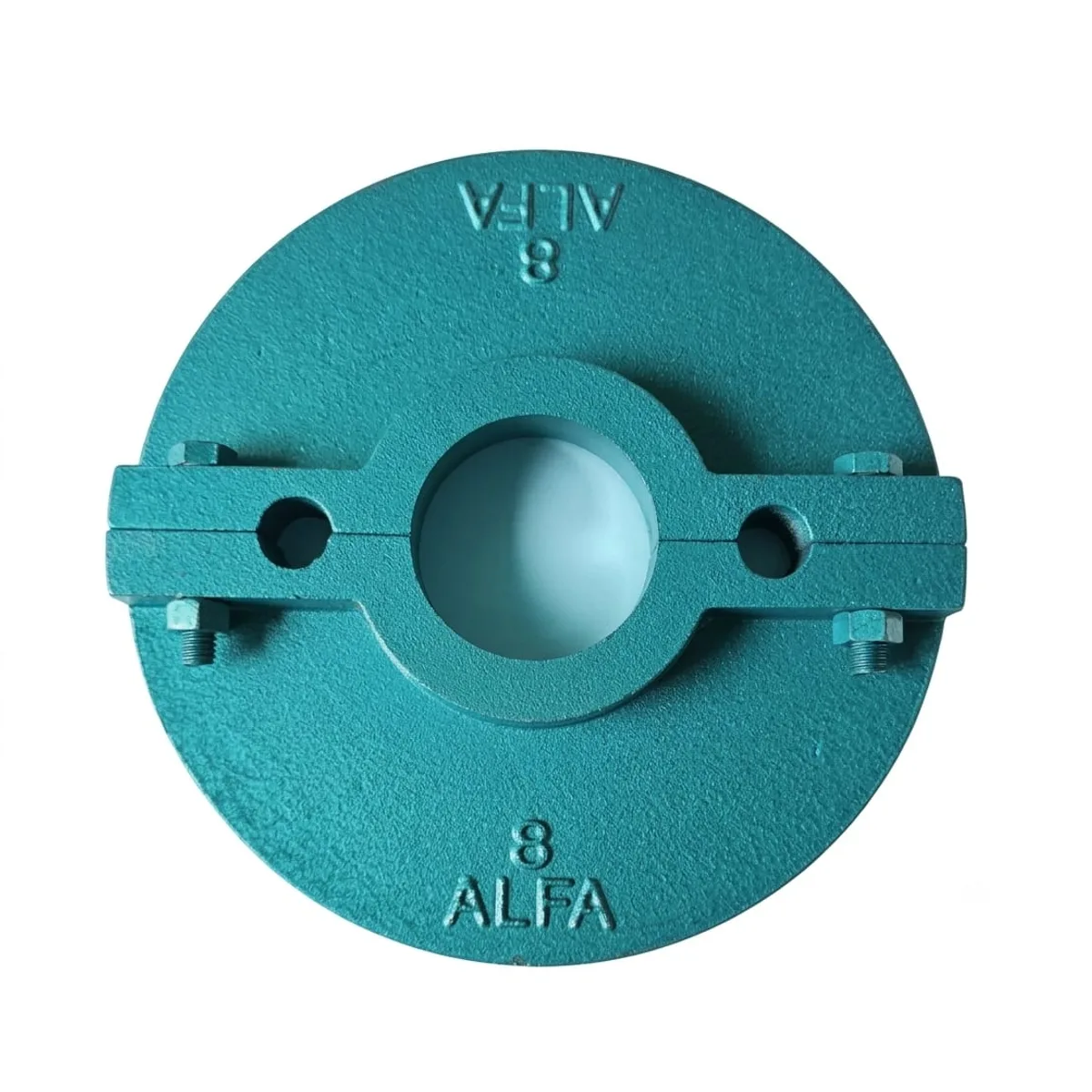
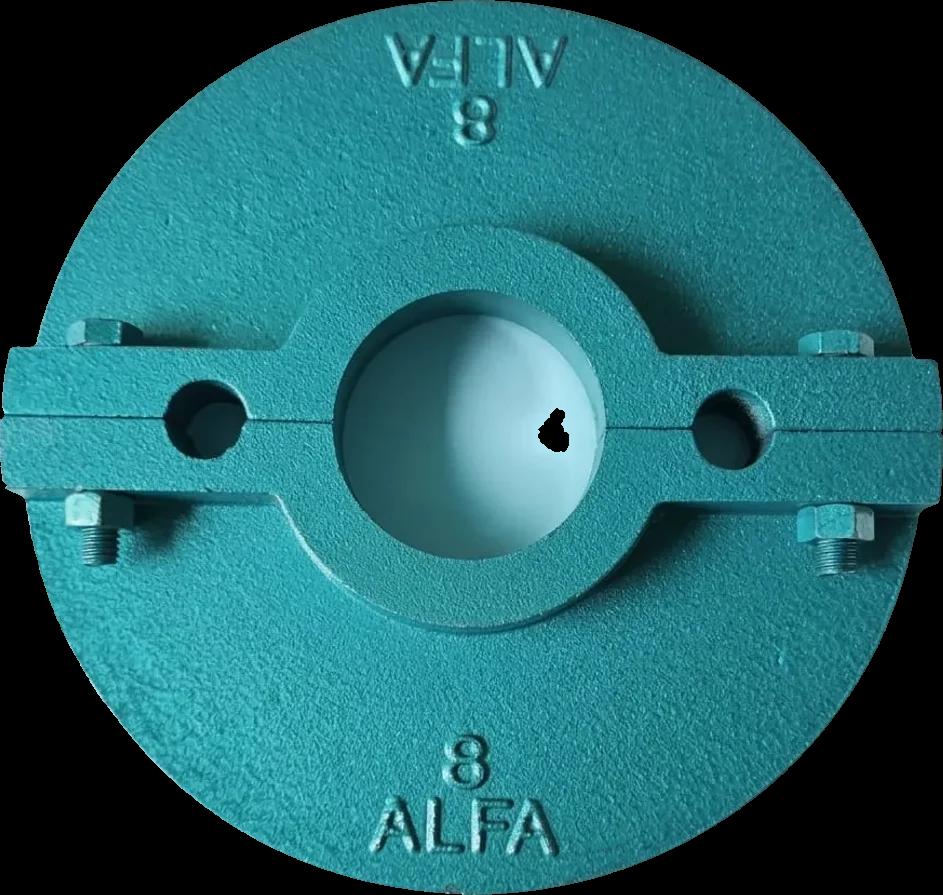
A cracked borewell cap is rarely a material problem. Grey cast iron is strong in compression and comparatively weak in tension, so a cap fails wherever the installation has managed to put the plate into tension or bending — and that is almost always one of four places.
Failure 1: the boss root
The most common crack runs around the base of the clamp boss, where the raised boss meets the flat plate.
That junction is a stress concentration. The entire hanging load — column pipe full of water, cable, pump — transfers through it, and any change of section in a casting is where a crack starts. Add a sharp internal corner and you have designed in a crack initiator.
What to specify instead: a generous fillet radius at the boss root, or a through clamp bar that carries load across the plate rather than into the boss. The ALFA 8" cap uses a through bar for exactly this reason, and it is the pattern we recommend for deep settings and heavy pumps.
Failure 2: overtightening the clamp bolts
A split clamp needs enough torque to grip the column pipe and no more. Beyond that the bolts stop clamping and start splitting — they load the two clamp halves apart, putting the boss into hoop tension.
Grey iron will take that load until it will not, and when it goes it goes without warning. There is no yielding first.
Tighten clamp bolts evenly and in sequence, alternating sides, until the clamp grips. A cap does not hold the pipe by bolt force alone — the clamp geometry does most of the work.
If a clamp will not grip at sensible torque, the clamp bore is wrong for the pipe. Do not solve it with a longer spanner.
Failure 3: seating on an uneven casing
A cap seats on the casing rim. If the casing has been cut with a cutting wheel and left uneven — high on one side, low on the other — the cap bears on two points instead of all round.
The plate then works as a beam between those two points, with the full hanging load at its centre. That is bending, that is tension on the underside, and that is a crack straight across the plate.
What to do: dress the casing cut flat before fitting. Five minutes with a grinder is cheaper than a cap, and far cheaper than recovering a pump.
Failure 4: casting defects
Shrinkage porosity, cold shuts and inclusions all reduce the effective section of a casting, and all of them hide below the paint.
This is a foundry problem, not an installation problem, and the defence is on our side of the transaction: controlled pouring temperature, correct gating and feeding so the section feeds properly as it solidifies, and inspection before despatch rather than after.
| Defect | What causes it | What it does to the cap |
|---|---|---|
| Shrinkage porosity | Section not fed as it solidifies | Reduces effective thickness, usually at the boss |
| Cold shut | Two metal streams meet too cool to fuse | A seam that behaves as a pre-existing crack |
| Inclusion | Slag or sand entrained in the pour | Local weak point, unpredictable location |
| Hard spot | Too-rapid cooling at a thin section | Brittle, and will not machine cleanly |
Why not just use a thicker cap?
Because thickness is not the variable that matters. A thicker plate with a sharp boss root still cracks at the boss root, and heavier sections in grey iron are prone to shrinkage unless the feeding is right.
Section transition matters more than section thickness. A cap with a well-radiused boss, even sections and no abrupt changes outperforms a heavier cap with sharp corners.
Grade and its limits
FG 260 has higher tensile strength than FG 200 and is the right choice for heavier duty. It does not change the picture above — a sharp corner is still a sharp corner, and an unevenly seated cap still bends. Grade raises the ceiling; geometry and installation decide whether you approach it. We cover the trade-off in cast iron grades for pump and bore components.
A short pre-fit checklist
- Casing cut dressed flat, all round
- Cap seats without rocking before any bolt is touched
- Clamp bore matches the column pipe — check, do not assume
- Bolts tightened alternately and evenly, to grip and no further
- Cable routed through the notch, not pinched under the clamp
Frequently asked questions
Why did my borewell cap crack?
Most cracks start at the root of the clamp boss, where the hanging load concentrates at a change of section. The other common causes are overtightened clamp bolts putting the boss into tension, and seating the cap on an unevenly cut casing so the plate bends between two high points.
Can a cracked cast iron borewell cap be welded?
Grey cast iron can be welded with nickel electrodes and careful preheat, but a repaired cap carries a load that will be dropped into a bore if the repair fails. For the cost of a cap it is not a sensible risk. Replace it.
Does a thicker borewell cap last longer?
Not necessarily. How the section changes matters more than how thick it is — a well-radiused boss on a moderate section outperforms a heavy plate with a sharp corner, and heavy sections in grey iron are more prone to shrinkage defects.
How tight should borewell cap clamp bolts be?
Tight enough that the clamp grips the column pipe, tightened alternately and evenly across the bolts. Beyond grip, additional torque pushes the clamp halves apart rather than gripping harder, and that tension is what splits the boss.
What is the difference between a cast boss and a through clamp bar?
A cast boss carries the hanging load into the plate at one junction. A through clamp bar spreads it across the plate. For deep settings and heavy pumps the through bar is the more forgiving arrangement.