Everything happens under one roof
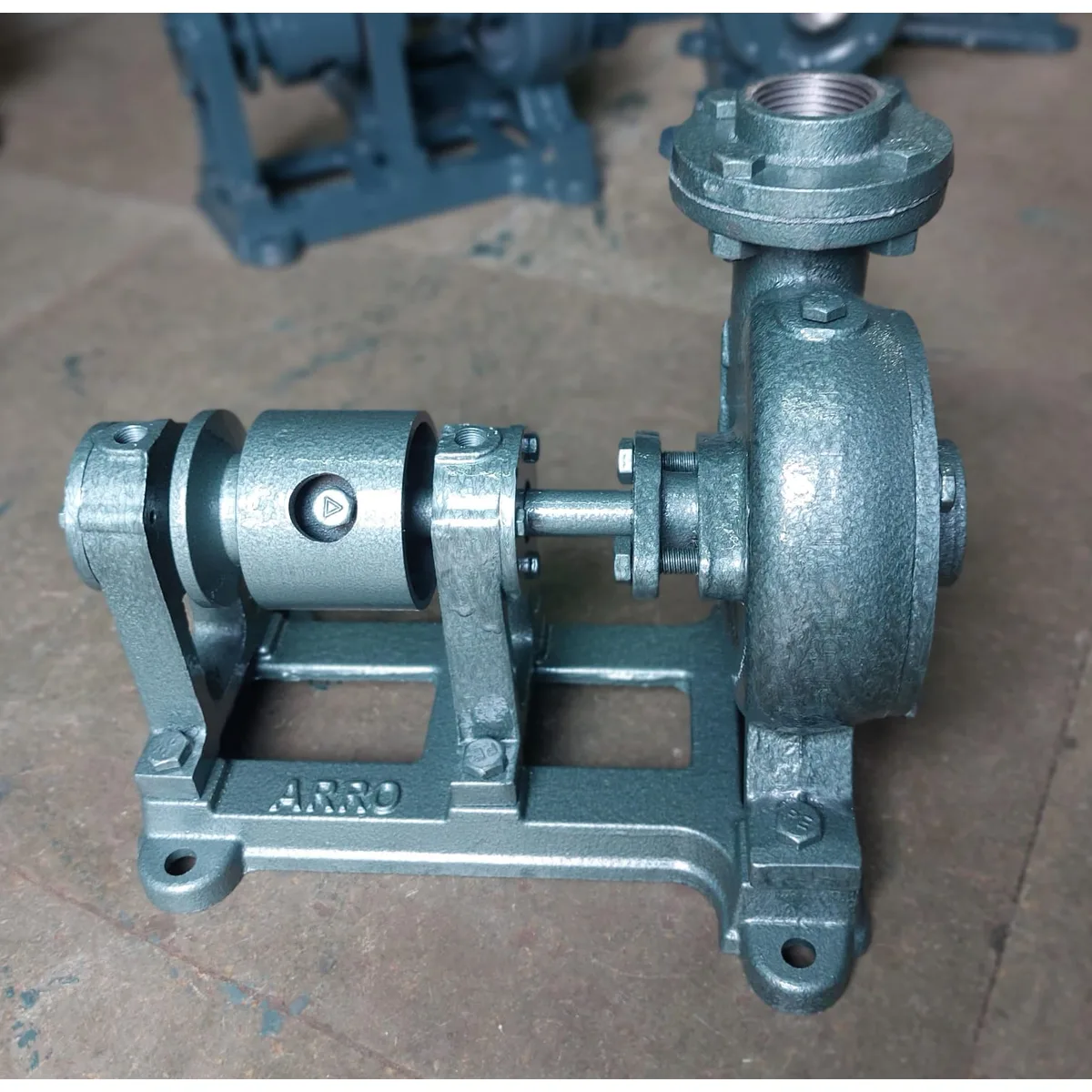
Much of the borewell hardware in this market is cast in one place, machined in another and painted in a third. Every handover is somewhere a dimension can drift. We pour, fettle, machine, test and paint at a single works in Rajkot.
- 01
Pattern making
Patterns are cut in-house. A customer drawing or a sample casting becomes a working pattern without outside tooling cost, and the same pattern is used on every repeat order, so a part ordered next year matches the one ordered today. There is no tooling charge on repeats.
No outside tooling cost · dimensions hold across repeat orders
- 02
Moulding and pouring
Green sand moulding, poured to IS 210 grade FG 200 or FG 260 chosen by the duty of the part rather than by whichever ladle is nearest. Section thickness is kept as consistent as the geometry allows — a casting that changes thickness abruptly cools unevenly and builds residual stress at the transition.
FG 200 and FG 260 to IS 210 · grade matched to duty
- 03
Fettling and shot blasting
Runners and risers are removed and the casting is shot blasted to a clean, even surface. This is the step most often skimped on elsewhere: paint will not hold on a surface still carrying sand and scale, and a cap that loses its coating in the first season starts rusting at the clamp faces.
Clean, even surface · paint adheres properly
- 04
Machining
Clamp faces, bores, spigots and port faces are machined on our own lathes and mills. Clamp bores are cut to the customer's actual column pipe outside diameter rather than a nominal one — a clamp that fits does not need over-tightening, and over-tightening is what cracks cast iron.
Clamp bore cut to your column pipe diameter
- 05
Testing
Pressure-containing castings are hydraulically tested individually, not by sample. A grade certificate tells you what the metal should be; it does not tell you whether a particular casting is sound. Gas trapped during pouring leaves voids, and on a pump casing that is a leak. Certificates travel with the consignment on request.
Every pressure casting tested · not sampled
- 06
Finishing and despatch
Enamel paint as standard, with primer-only, black bitumen and hot-dip galvanising available against bulk orders. Size and pattern are cast into both faces so the correct part stays identifiable on site long after installation.
Enamel standard · primer, bitumen or galvanised to order
Why we machine what we pour
When a clamp does not fit the column pipe, the fitter compensates with the spanner. Cast iron is strong in compression and weak in tension, so the boss cracks across the split line — sometimes immediately, more often weeks later.
Controlling the machining means we can cut the clamp bore to the pipe that will actually go through it. It also means that when a casting comes back, we can look at the fracture surface and know which step produced it.
What to ask any foundry
Which IS 210 grade, and will you certify it?
We pour FG 200 and FG 260, and issue certificates on request.
Are pressure castings tested individually or by sample?
Individually. Sampling tells you about the batch, not your part.
Is the pattern yours, and will it hold on a repeat?
Ours, cut in-house, and used unchanged on every repeat order.