8 min readArrow Industries
Cast Iron vs Mild Steel Borewell Caps: Which to Specify
A fabricated steel cap is cheaper to make in ones and twos and stronger in tension. A cast iron cap resists corrosion better, damps vibration, and comes out of the mould with the clamp geometry already in it. When each one is the right call.
Both materials are used for borewell caps and both work. They fail differently, cost differently, and suit different situations — so the honest answer to "which is better" is that it depends on quantity, environment and how the clamp is formed.
The short version
| Cast iron (grey, IS 210) | Fabricated mild steel | |
|---|---|---|
| Tensile strength | Low; no ductility | High; ductile |
| Compressive strength | Very high | High |
| Corrosion in a wet bore | Slow, forms a protective surface | Faster; depends entirely on coating |
| Vibration damping | High | Low |
| Clamp geometry | Cast integrally, one piece | Welded up from parts |
| Cost in ones and twos | Pattern cost dominates | Cheaper |
| Cost at quantity | Lower per piece | Labour per piece does not fall |
| Failure mode | Cracks, without warning | Bends or tears, with warning |
| Repairable on site | Not practically | Yes, by welding |
Where cast iron wins
Corrosion. A bore mouth is wet, more or less permanently. Grey iron corrodes slowly and the graphite-rich surface that forms slows it further. Mild steel depends on its coating, and a coating gets chipped during installation at exactly the spot that then sits in water.
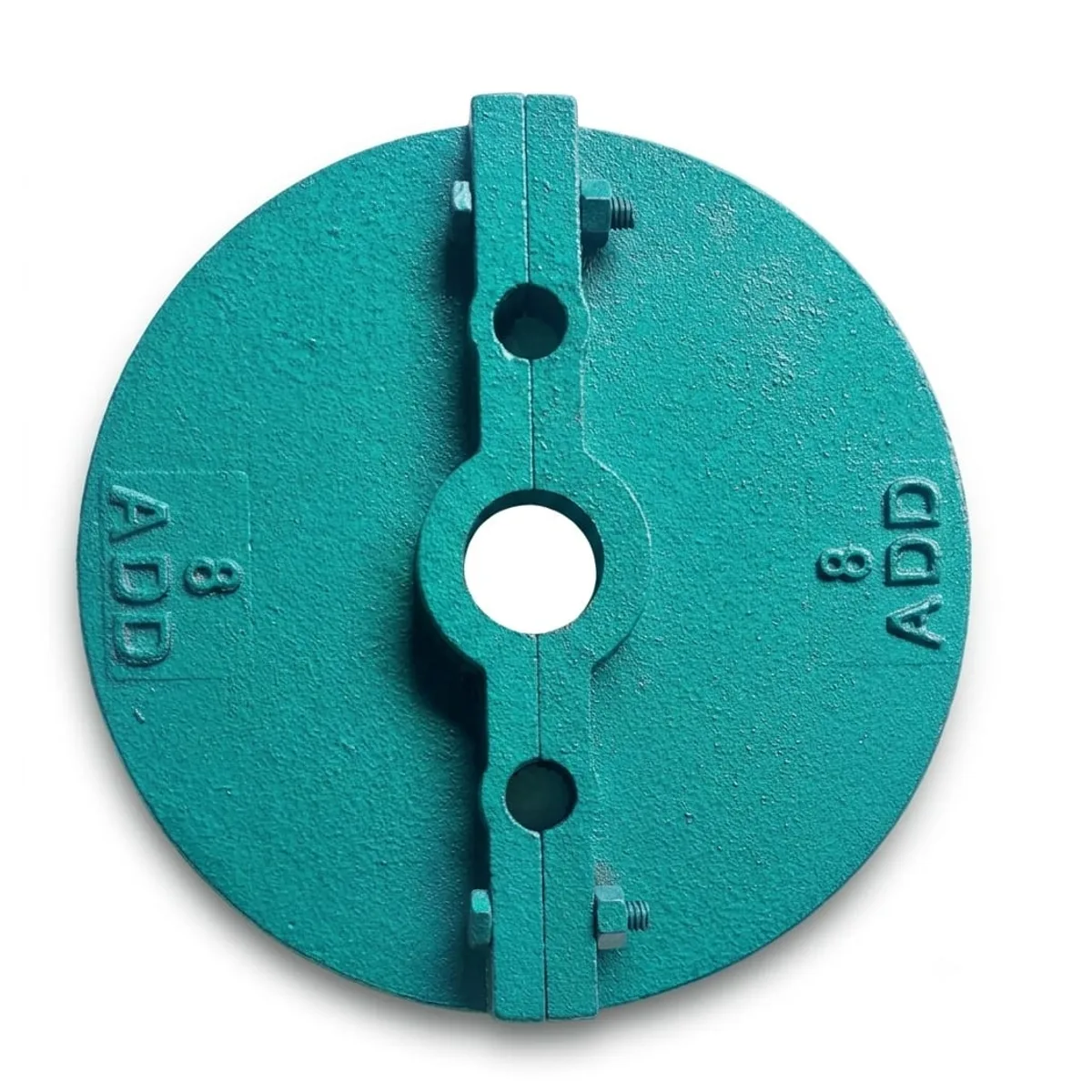
The clamp comes out of the mould. A cast cap has its boss, split clamp and cable notch formed as part of the casting, in one piece, with no joints. A fabricated cap has them welded on, and every weld is a place where the heat-affected zone has different properties from the parent metal.
Damping. Flake graphite absorbs vibration. On a bore with a running pump this is not cosmetic — it reduces what the fasteners and the casing see over years of service.
Repeatability at quantity. Once the pattern exists, the hundredth cap is the same as the first. A fabricated cap is as consistent as the fitter who welded it.
Where mild steel wins
One-offs and odd sizes. Making a casting needs a pattern. For a single cap in a size nobody stocks, the pattern cost dominates and fabrication is simply cheaper and faster.
Tensile and impact loads. Steel bends before it breaks. If a cap is going to be struck, or loaded in a way that puts the plate in real tension, that ductility is a genuine safety property — a steel cap deforms and gives warning, where a cast cap cracks without any.
Field repair. A steel cap can be welded on site by anyone with a set. A grey iron cap can be welded with nickel electrodes and preheat, but for a part carrying a pump over an open bore, a repair is not a sensible risk.
How they fail
This is the difference that matters most and it is the one least often discussed.
Cast iron fails suddenly. It has essentially no ductility, so there is no bending, no sagging, no visible warning — it is intact and then it is in two pieces. Everything hanging below goes down the bore.
Steel fails gradually. It yields, deforms, and usually gives enough warning to be noticed on an inspection.
That argues for steel on paper. In practice the comparison is decided earlier, because a correctly specified cast cap on a dressed casing is not close to its limit in normal service — the loads are compressive and distributed, which is the regime grey iron is good at. The caps that fail are the ones installed on uneven casings or overtightened, and we cover both in how to install a borewell cap.
Cost, honestly
For a single cap in a non-standard size, fabrication wins. The pattern is the whole cost of a casting and there is nothing to amortise it over.
For standard sizes in any quantity, casting wins and the gap widens with volume. Pattern cost is already paid, the per-piece cost is metal plus a little machining, and fabrication labour per piece does not fall the way casting cost does.
For dealers and OEMs ordering repeatedly, casting also wins on something that does not appear on an invoice: every piece is identical, so a fitter who knows the part knows every one of them.
What we pour and why
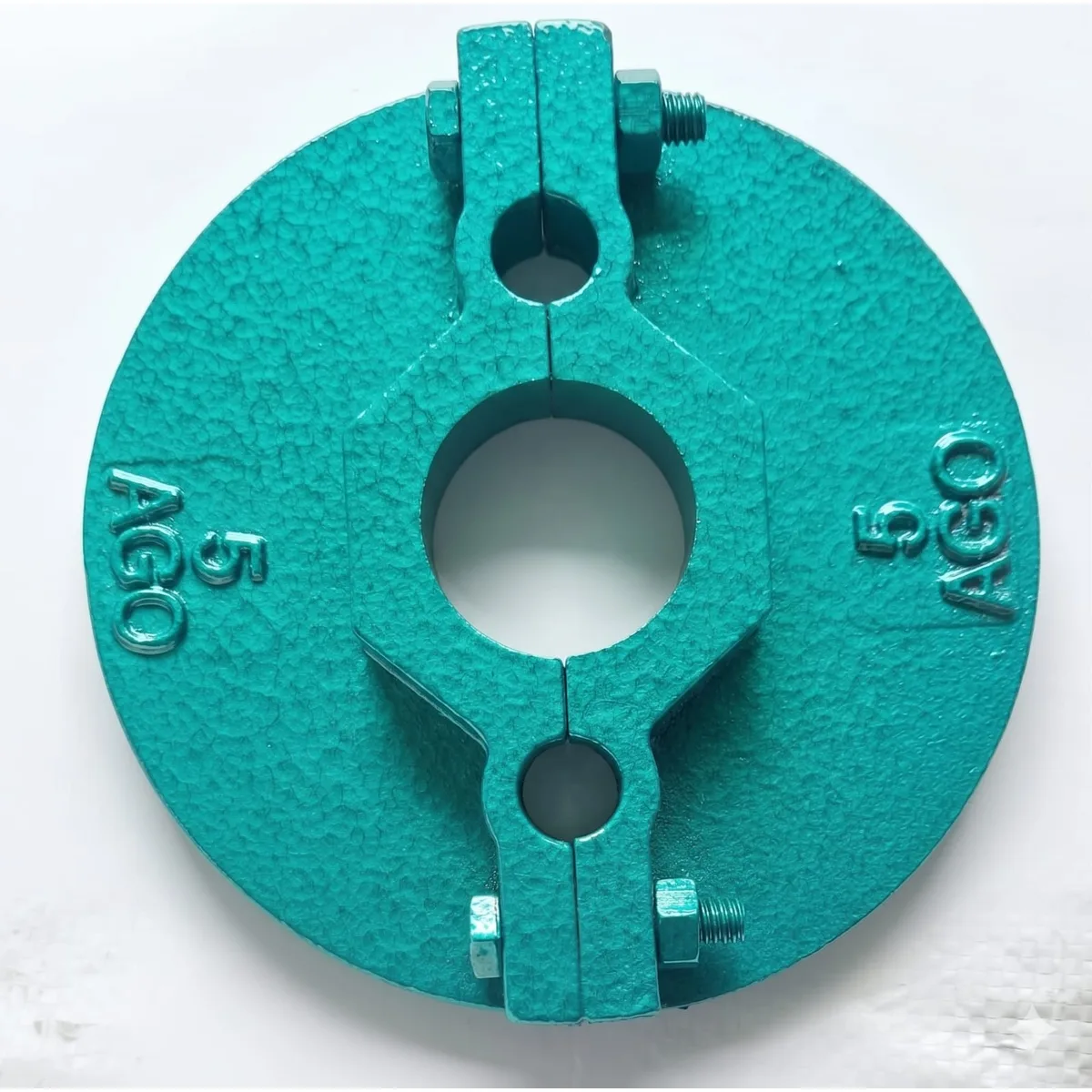
All our caps are grey iron to IS 210, in FG 200 or FG 260 according to duty — the reasoning is in FG 200 vs FG 260. Standard sizes run 4" through 9", so for the overwhelming majority of bores there is no pattern cost to carry. See the borewell cap range or the AGO 5" split clamp cap, which is the common domestic and agricultural size.
Frequently asked questions
Is a cast iron or mild steel borewell cap better?
For standard sizes in any quantity, cast iron: better corrosion resistance in a wet bore, integral clamp geometry with no welds, better damping, and a lower per-piece cost once the pattern exists. For a one-off in a non-standard size, fabricated steel is cheaper and faster.
Do cast iron borewell caps rust?
They corrode, but slowly. Grey iron develops a graphite-rich surface layer that slows further attack, which is why it holds up at a permanently wet bore mouth better than coated mild steel, whose coating gets chipped during installation.
Why are borewell caps made of cast iron rather than steel?
Because the clamp, boss and cable notch can be formed in one piece in the mould with no welded joints, because grey iron resists corrosion at a wet bore mouth, because it damps pump vibration, and because at quantity it is cheaper and more repeatable than fabrication.
Can a mild steel borewell cap be galvanised?
Yes, and it should be if it is going into a wet bore. Galvanising addresses the main weakness of steel in this application, though any coating is vulnerable to chipping during installation.
Which fails more safely, cast iron or steel?
Steel. It yields and deforms before it breaks, giving visible warning. Cast iron cracks suddenly with no warning. In normal service a correctly specified and correctly fitted cast cap works in compression and is nowhere near that limit.